
May Day M’aider, from Antarctica, Part 1
It’s May Day — a time to honor the bounty of nature and hard work, and a distress call derived from French, m’aider ("help me"). So, this is a perfect day to launch Thin Ice, which celebrates nature and the hard work of preserving wild spaces while sounding an international plea for action.
Co-hosts Robert Swan (the first person to walk to both the South and North Poles) and Dan Smith share stories from the wild in hopes of inspiring people to appreciate and protect the remaining wild places on Earth, especially Antarctica.
Episode 1 features William Fenton, the first person to volunteer to help Robert ultimately raise (US) $5 million in the early 1980s to fund the first private expedition to the South Pole in the modern era.
Together, Robert and William didn’t make London Bridge fall down, but Southern Quest, their expedition ship, did bash into London’s Tower Bridge. And that was just the start of their entertaining yet death-defying adventure.
Thin Ice Manifesto: Thoughts on Episode 1
Naïveté is underrated
By Dan Smith
In Thin Ice, Episode 1, our guest is William Fenton, the first person to volunteer to support Robert’s walk to the South Pole, completed in 1986-87 but in planning for years before.
It’s one thing to say, “I’m going to walk to the South Pole,” as Robert pledged to his parents when he was 11. It’s an entirely different thing to raise $5 million years later (worth about $20M in 2025), corral dozens of volunteers and thousands of donors, buy and outfit a ship for the Southern Ocean, gather a year’s worth (tons of tons) of supplies, drain 2K cans of donated beer, and withstand government hostility — all so Rob and two others could spend 70 miserable days walking 900 miles into the teeth of Earth’s most inhospitable conditions.
Can you imagine saying, as William did, “Sure, I’ll help you with that.” That’s the story of Thin Ice, Episode 1.
I’ll tell you, there may be some naïveté at play in this tale — naïveté as in attempting something everyone says is impossible because you either don’t know or won’t accept that it can’t be done.
If necessity is the mother of invention, then naïveté is the fun uncle of exploration and adventure. It’s at the root of many of my proudest moments. I'm tempted to say some degree of naïveté was at work when Robert told his parents he would walk to the South Pole some day — in honor of a man (Capt. Robert Falcon Scott) who died trying in 1912.
If Robert had truly realized all he would have to fight through many years later, he might have stuck to playing rugby with his mates and attending Oxford as his father wanted. He might have listened to people who repeatedly said, “You are going to die.”
On further reflection, though, there's nothing naive about Robert Swan. We've been friends a few years now, having spent 11 days together at his Undaunted expedition's base camp (Union Glacier Camp in West Antarctica) and pursuing new projects together ever since. For Robert, doing something widely deemed impossible is a feature, not a problem. He's his own fun uncle, and determination is one of his defining traits!
So Robert walked to the South Pole and then the North Pole — followed by a lifetime of expeditions that seemed implausible if not impossible to outsiders. The associated teams with him have varied, but Robert remained the catalyst. It all adds up to an extraordinary lifetime of experiences calculated to inspire positive change worldwide.
Through these efforts, Robert has reached millions of people — probably hundreds of millions considering mass media — with a positive message about caring for each other and taking care of Earth. He especially advocates for protecting wild places and most especially, Antarctica — the canary in Earth’s coal mine with inherent value all its own.
My favorite quote from Robert is, "The greatest threat to our planet is the belief that someone else will save it."
It begins with one change
Robert and I are asking you to make one change, however small, to treat the natural world more kindly and respectfully. Become an explorer and make it an adventure to find the next change and the next.
Robert says, “The last great exploration on Earth is learning to live sustainably on it.” I call it, “The Next Great Adventure: Living sustainably on Earth.”
Can one new good habit really change things? Meh. But another? Maybe. And another? That’s becoming a habitual ground swell!
The difference between a leaky faucet and a tsunami is that all the drips in the tsunami are doing the same thing in the same direction.
Like Dr. Seuss’ Lorax, we speak for the wild, but we are not lonely voices lost in the wilderness. Already, millions upon millions of people are taking action to live differently and walk ever more lightly on our planet. Embrace naïveté and join us. We can do this!
Of course, naïveté is not a call to be stupid. Pay attention to red flags — like the ones marking the crevasse zones outside Union Glacier Camp. Seriously. Red flags. Pay attention!
Also, please don’t mistake my appreciation for the power of naïveté as oblivious optimism. I am inherently optimistic but also deeply pessimistic about certain people and aspects of human nature. Ignorance is bliss, and abundant — ranging from the innocent to the willful and malicious varieties. Naïveté pumps up my urgency for urging humans to rise to our better natures.
I refuse to go quietly into the ignoble night that will come if humanity fails to protect what’s left and restore what’s been lost. The solution is within a common commitment that binds us — even if we’ve never met. We are, as Nanci Griffith sang, each other’s friend out in the madness.
Hello, friend. I’m talking to you. From somewhere in the madness.
The tie that can bind us begins with one thing. One action at a time. And then another and another. Yeah, that sounds naive. Let’s go for it!
Until next time …
Keep Earth wild. Be kind. And chill out.
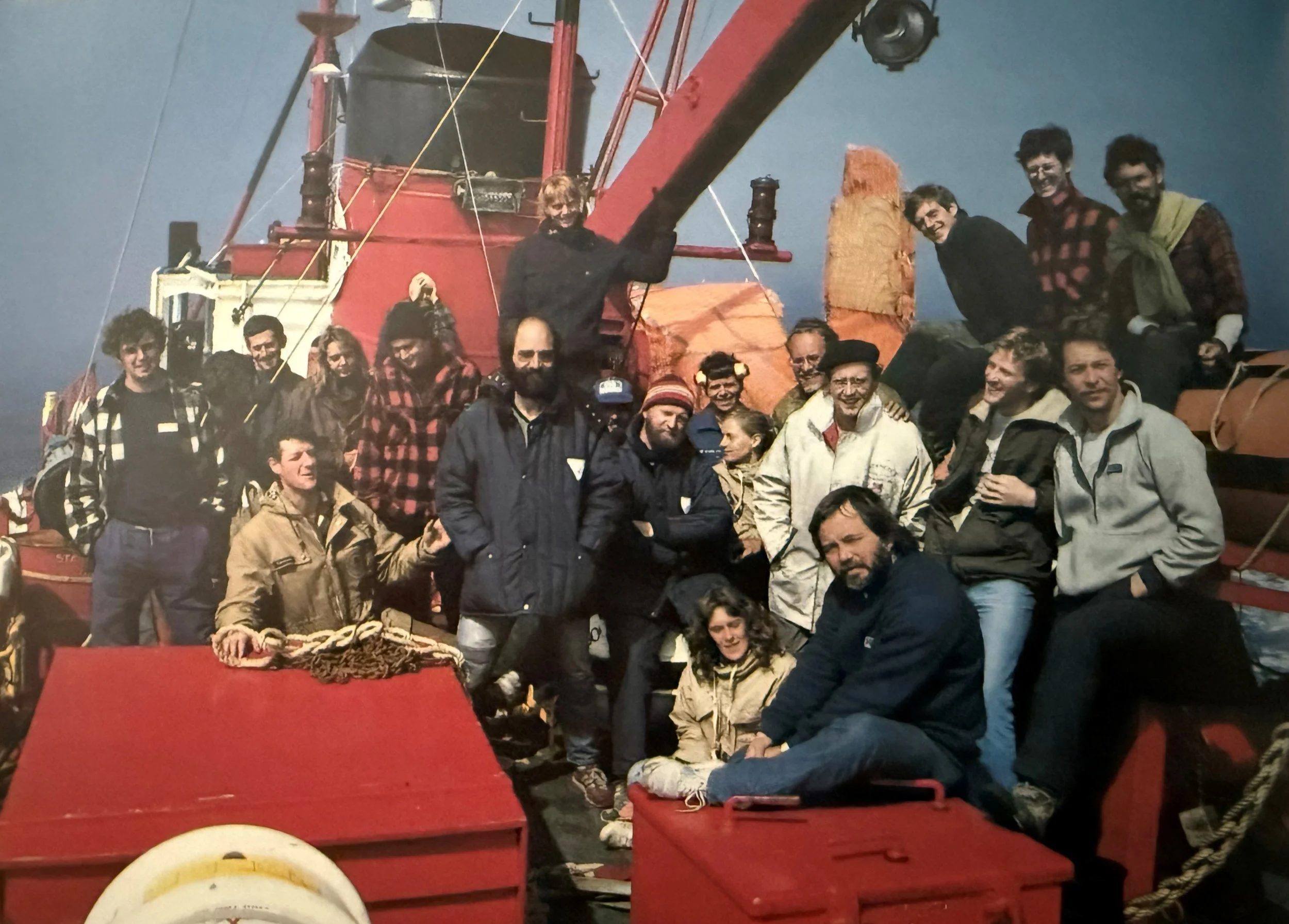
Southern Quest crew: Steve Broni, Giles Kershaw, Graham Phippen, Peter Malcolm, Rebecca Ward, John Elder, Ted Addicott, Kurt Czech, Sarah Robert-Tissot, Edi Frosch, Bruno Klausbruckner, Peter Robb, Lynn Davis (sitting), Thea de Moel, Wolfgang Axt, William Fenton, Ric Mason (front), Andrew Robert-Tissot, David Iggulden, Daryl (Dibble) Jones, Ed Saunier, Tim Lovejoy. (All photos are from "In the Footsteps of Scott" by Roger Mear and Robert Swan, published by Jonathan Cape, 1987. Out of print but copies still available.)
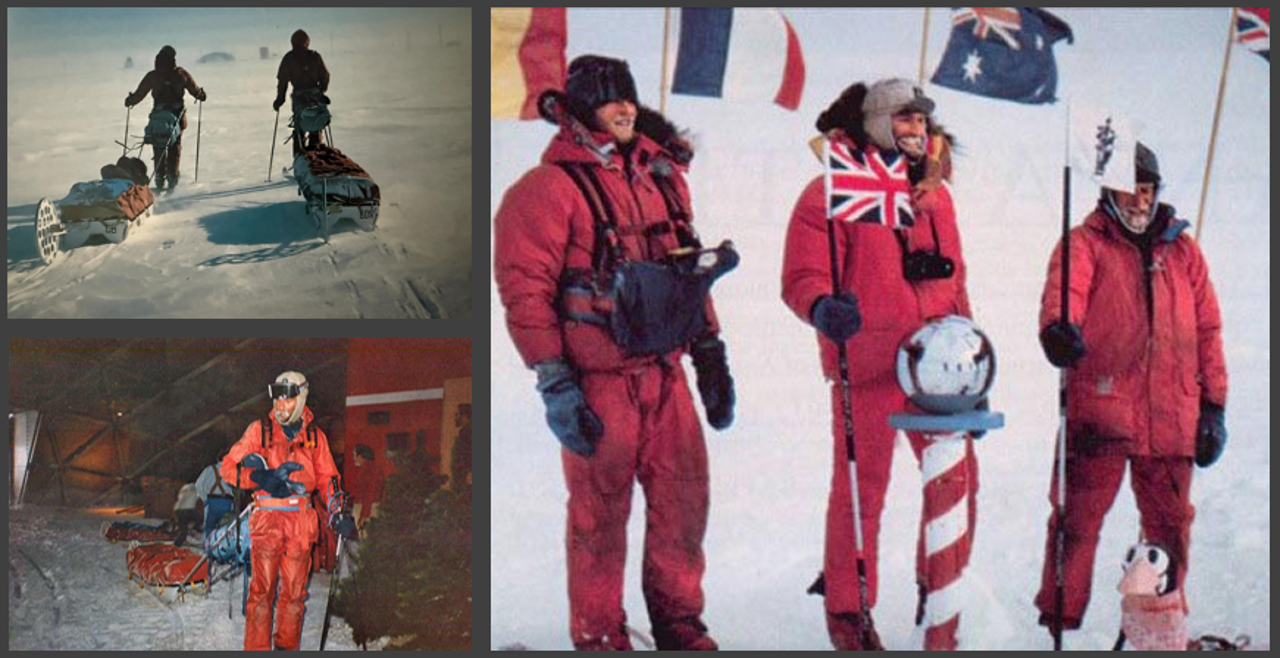
On January 11, 1986, while Southern Quest is trapped in ice, the expedition pole walkers spot the Amundsen-Scott South Pole Station, after 70 days of a grueling march.